A standard Hold’em starting-hand chart contains 169 cells, yet a count of the individual two-card holdings produces 1,326 combinations. Both totals describe the same game. The grid groups cards by rank and whether their suits match; the larger number keeps track of the particular cards. Reading the chart starts with knowing which of those two things a cell represents.
Those groups come from a standard deck: four suits, each containing 13 ranks. Rank identifies the card values present in a holding. Suit relationship identifies whether two different ranks share a suit. The starting-hand grid retains both pieces of information while leaving out the exact suit identities, allowing equivalent holdings to share a label.
In Texas Hold’em at online poker tables, each player receives two private cards before the shared board develops. Starting-hand charts compress those holdings into labels that are easier to scan than a list of every possible pairing. The compression keeps the distinction between pairs, suited hands, and offsuit unpaired hands, but it does not give every label the same likelihood of being dealt.
Counting the Actual Two-Card Deals
Counting those holdings means preserving the identity of each card. Hold’em begins with two private hole cards per player. The first has 52 possibilities; the second has 51 because one card is already accounted for. Multiplying gives 2,652 ways to record the cards in order.
Every two-card holding appears twice in that ordered count. Reversing the order identifies the same cards, so dividing 2,652 by two gives 1,326 combinations. Both cards remain fully identified; only their order has been discarded. Counting first and second cards separately without that division would double the total.
The 1,326 figure is a complete inventory of possible private holdings from a full deck before any cards are known. It does not count community boards, betting sequences, or the different ways a hand can develop after the flop. Those require separate calculations. Here, the question concerns only which two cards make up the starting holding.
The Numbers Behind the Grid
To build the smaller count, replace each exact holding with a type. A pocket pair contains two cards of the same rank. There are 13 ranks, so there are 13 paired types. Changing the suits within a pocket pair leaves its rank category intact.
An unpaired holding needs two different ranks. There are 13 choices for one and 12 for the other. As with the card count, choosing the same two ranks in the opposite order does not create a new rank pairing. The 156 ordered choices reduce to 78 distinct pairs of ranks.
Each rank pairing then splits according to whether the cards share a suit. That gives two types for every unpaired rank combination: 78 suited and 78 offsuit. Adding the 13 pocket-pair types produces 169.
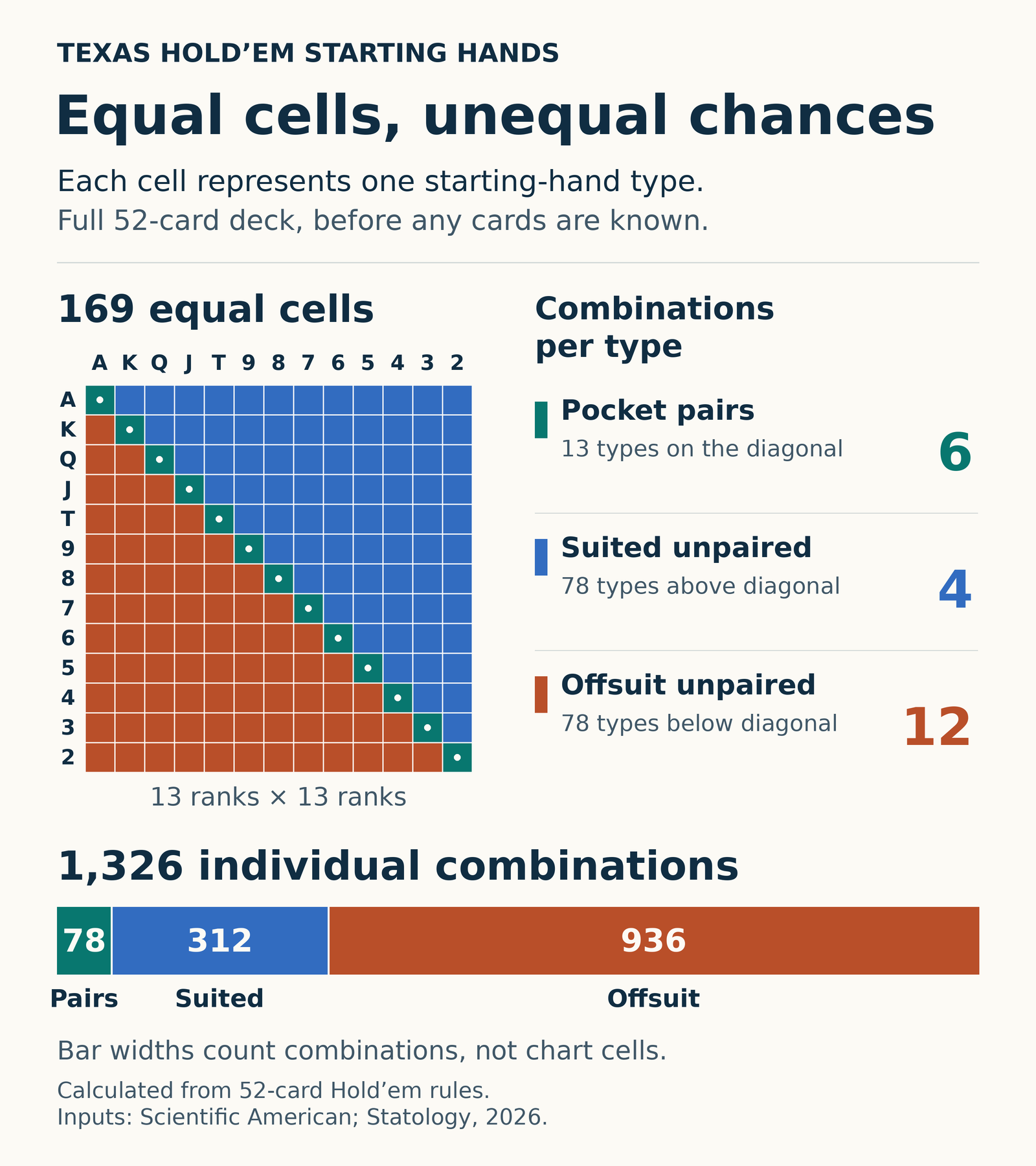
On a 13-by-13 grid, the paired types occupy the diagonal. The two halves on either side separate the suited and offsuit versions of the different-rank holdings. Each half has 78 cells, making both groups equally large on the page. The grid’s two rank axes identify the ranks together, while the cell’s position identifies their suit relationship. Its shape organizes types rather than measuring their frequency.
Equal Cells, Different Combination Counts
Returning from types to individual cards reveals how much each cell has compressed. A paired type uses two of the four cards bearing one rank. Four choices for one card and three for the other give 12 ordered selections. Dividing by two leaves six different combinations.
For any two different ranks, each of the four cards of the first rank can combine with each of the four cards of the second. That creates 16 combinations. Four match suit, one in each suit. The other 12 are offsuit. A suited cell therefore covers four combinations, while its offsuit counterpart covers three times as many.
| Starting-hand group | Types | Combinations per type | Total combinations |
| Pocket pairs | 13 | 6 | 78 |
| Suited unpaired | 78 | 4 | 312 |
| Offsuit unpaired | 78 | 12 | 936 |
The combination totals add to 1,326, reconnecting the grid to the deck.
Before any cards are known, the dealing probability of a type is its combination count divided by 1,326. The denominator stays the same across the table, while the numerator changes. A chart’s colored area can therefore describe a share of its cells without describing the same share of all possible two-card deals. Neither proportion, by itself, measures the strength of those holdings or establishes which should be played.
From Deck Frequencies to a Played Range
These frequencies describe holdings before any cards are known. Once private or community cards are visible, they cannot also appear among an opponent’s available cards. Full-deck counts therefore differ from the combinations still possible during a hand.
Suit identities can also become relevant as the board develops. Cards grouped together before the flop no longer share every detail of their relationship to the community cards, even though their starting-hand label remains unchanged.
Observed actions add another filter. A range is the collection of holdings a player could have, given the available information at that moment. Choices about which hands to enter with and how to play them can weight types differently from their frequency in the deck. Card counts describe what can exist; they do not establish how often someone selects each possibility. A range estimate must account for both available combinations and the actions taken, rather than treating each surviving chart cell as equally likely.