
A video poker explanation can give a flush draw a 17.02% chance, while another gives the same draw a 19.15% chance. Both figures can be correct. One counts only the ordinary flush category; the other includes a royal flush. Another distinction matters just as much: whether the percentage describes the first five cards dealt or a draw made after those cards are known.
An ordinary flush contains five cards of one suit that do not form a straight. A royal flush has the ten, jack, queen, king, and ace of one suit, making it a special straight flush. Scientific American’s explanation of how poker hand rankings relate to frequency describes why a full house ranks above an ordinary flush in a standard five-card deal: the full house occurs less often.
Video poker adds a decision between the initial deal and the completed hand. You see five cards, choose which to hold, and draw replacements for the rest. When you play video poker games for real money, the final hand is evaluated against a paytable: a list of qualifying hands and their payouts. A probability for the initial deal and a probability for a particular draw therefore describe different stages. Knowing what you already hold changes the question from how often a hand appears to which replacements can complete it.
The Five Cards Already Dealt
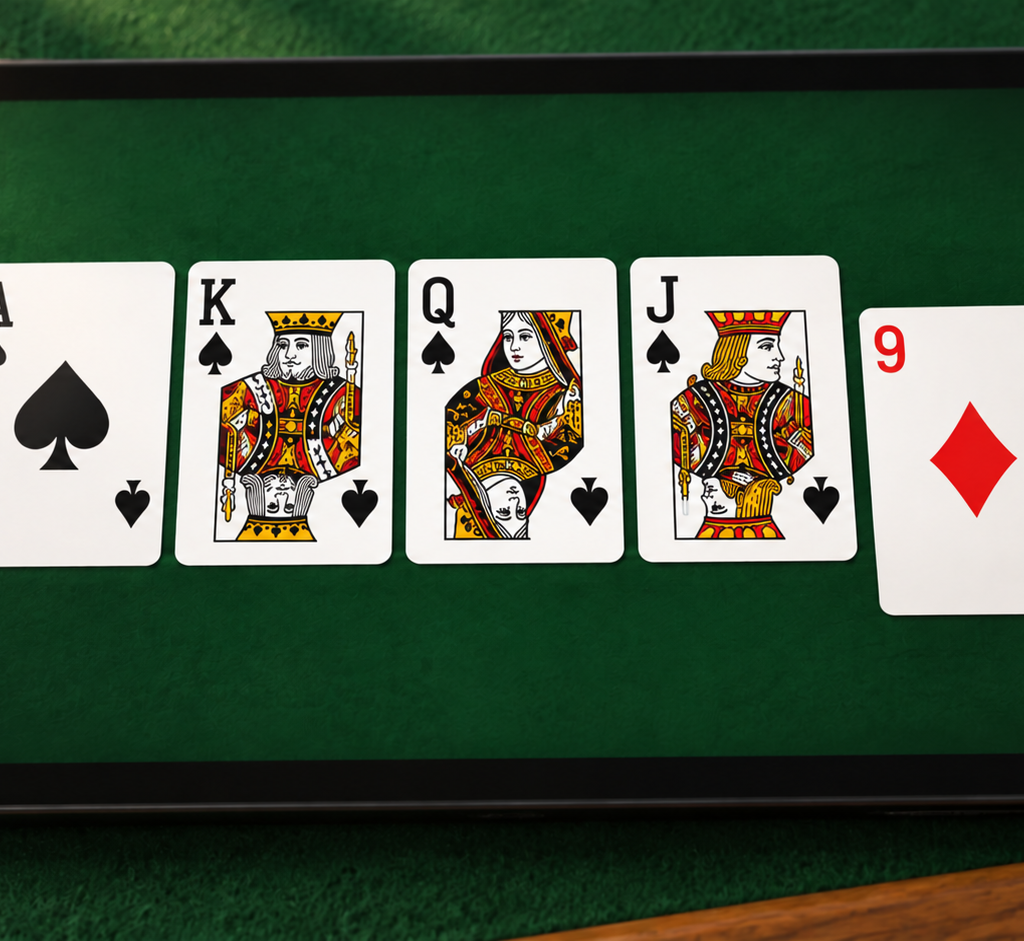
Consider a hypothetical single-hand Jacks or Better example using a standard 52-card deck, no wild cards, and one draw. The initial hand is A♠ K♠ Q♠ J♠ 9♦. Suppose you hold the four spades and discard the diamond. That leaves one space to fill, with four cards already fixed in the completed hand.
There are 47 possible replacement cards. All five cards from the initial deal are excluded from the draw, including the discarded 9♦. Discarding it does not put it back among the available cards. Each of the remaining 47 cards is equally likely under this model.
Each of the four suits in a standard deck contains 13 cards. Four spades are already held, leaving nine available. The denominator, the total number of possible replacements, is 47, not 48 or 52. Holding four cards does not erase the fifth card from the information already known about the hand.
Where the Nine Spades Go
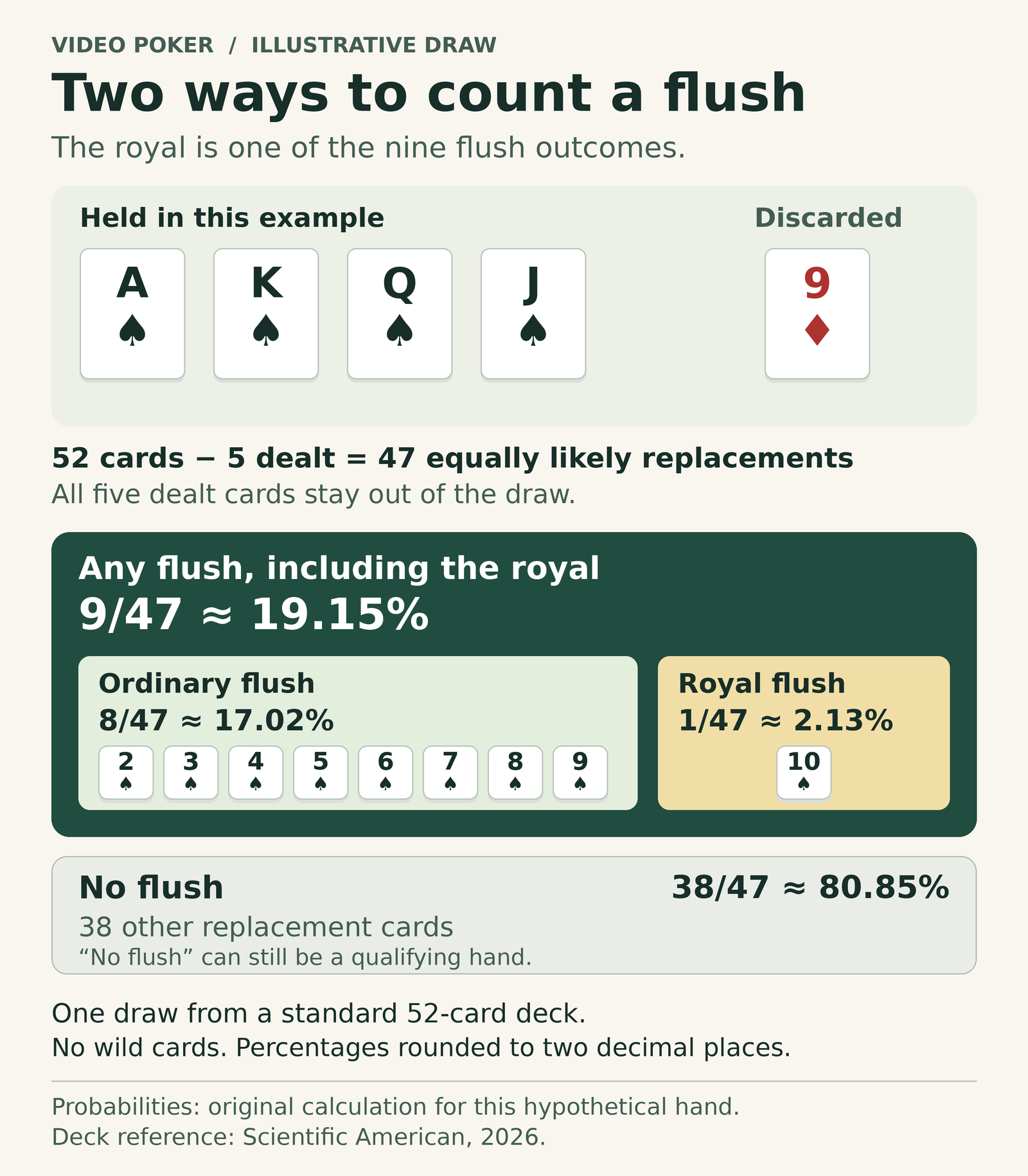
Only the 10♠ completes a royal flush. Each of the other eight available spades, from the 2♠ through the 9♠, completes an ordinary flush. None makes another straight flush: with A♠ K♠ Q♠ J♠ held, the only card that completes a consecutive sequence in spades is the ten.
The 38 remaining replacements are hearts, diamonds, or clubs. They cannot make a flush with those four held spades.
| Final category | Replacement cards | Probability |
| Royal flush | 1 | 1 in 47 (2.13%) |
| Ordinary flush | 8 | 8 in 47 (17.02%) |
| No flush | 38 | 38 in 47 (80.85%) |
Every possible replacement belongs to exactly one row. The counts add to 47, and the percentages are each count divided by 47, multiplied by 100, and rounded to two decimal places.
To count any flush, including the royal, combine the first two rows. Their nine cards give a probability of 9 in 47, or approximately 19.15%. The royal is already included in that figure. Adding its probability again would count the same replacement twice.
Some explanations use odds against instead of percentages. Here, 38 cards fail to complete any flush and nine complete one, giving odds against of 38 to 9. The probability remains 9 in 47 because its denominator includes both groups. The two formats express the same chance.
What These Percentages Leave Out
“No flush” does not mean “no qualifying hand.” Drawing the 10♥ produces a straight. Drawing the J♥ produces a pair of jacks. Both belong among the 38 non-flush outcomes, even though they qualify in standard Jacks or Better.
As this video poker explainer describes, players choose which cards to hold before drawing replacements. This calculation assumes one particular hold. Keeping different cards changes the possibilities. Comparing holds requires you to consider their possible final categories and the applicable paytable, rather than only the chance of completing a flush.
These figures apply to the specified 52-card game without wild cards. A different deck composition changes the available replacement cards, while wild card rules can change how a completed hand is classified.
Reading the Result
A probability also does not specify what must happen over a short run of hands. The nine counts the spades available for this one draw; it has no bearing on how following hands might unfold.
Economist Carlos Alós-Ferrer describes outcome bias as judging decisions by their results. That distinction helps keep a completed draw separate from the reasoning used beforehand. One observed card cannot establish that a hold was preferable to every alternative.
A heart on the draw would not invalidate the 19.15% flush probability. Neither would a spade prove that a flush was assured. Both possibilities were included before the replacement appeared. The percentage describes the possible outcomes under the stated conditions; the completed hand shows which one occurred.