
Chris Moneymaker’s route to the 2003 World Series of Poker is still a powerful invitation to dream. An online satellite led to a seat in the Main Event, where he beat Sammy Farha heads-up and won $2.5 million. The WSOP’s account of the 2003 championship describes how a recreational player’s victory helped ignite the poker boom.
The visible part of that story is the extraordinary result. The useful part for someone choosing an online room is the route: a particular event, entered at a particular time, offering a particular prize. A room becomes relevant when its actual games fit a player’s circumstances. A large welcome banner cannot answer that question.
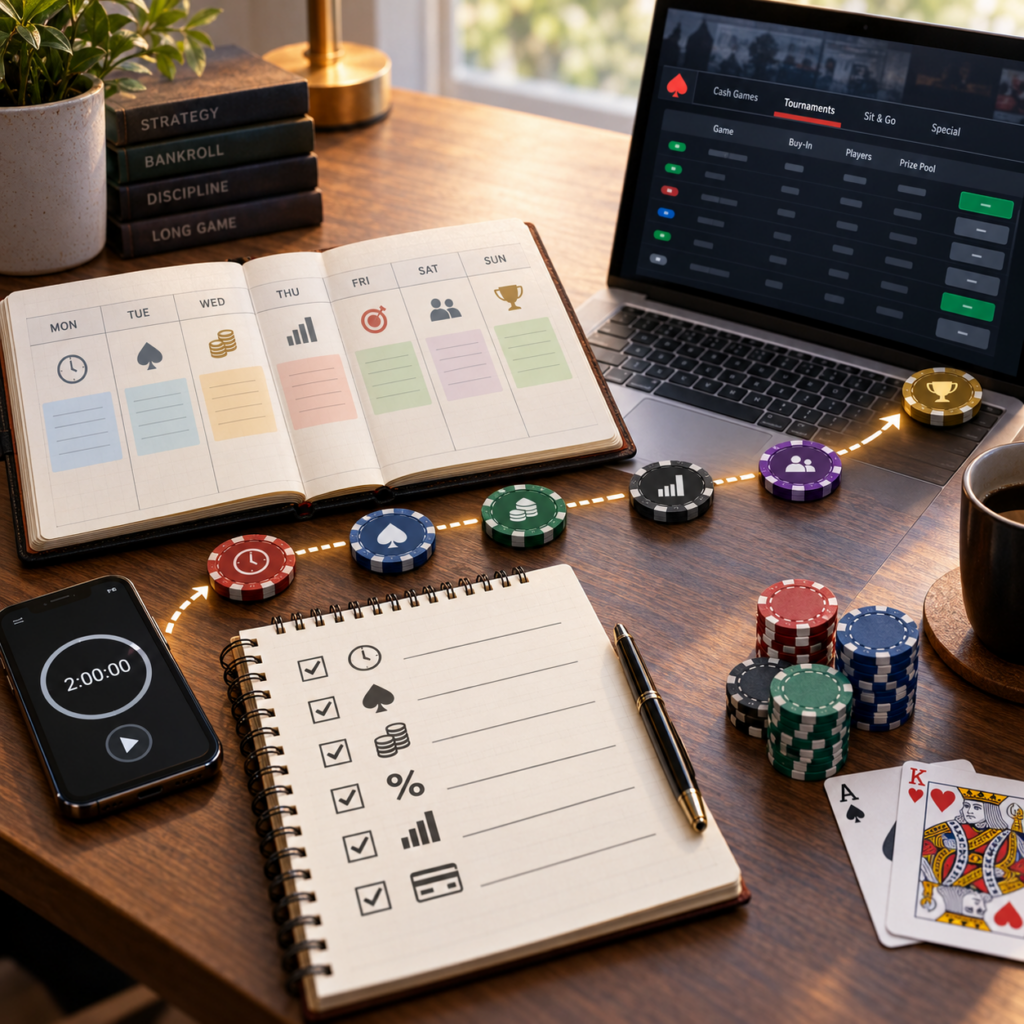
Before comparing sign-up offers, write a one-week playing plan. It takes the room-selection decision out of the abstract and exposes the conditions that a comparison table can easily hide.
Start with the time you actually have
Write down the days you expect to play and the point at which you must stop. Use your ordinary week, including work and family commitments. A tournament beginning at a convenient hour can still be a poor fit if its likely duration extends far beyond your available time. Late registration, re-entry periods and tournament structure all deserve attention.
For cash games, the question changes. You need suitable tables running during those hours, with limits and buy-in requirements that match your budget. A busy lobby at a different time of day does not settle that question. Check the lobby at the hours you intend to use it, where access permits, and record what you can actually observe.
A simple schedule might allow two evenings of 90 minutes. That is a hypothetical planning example, not a recommendation for how often to play. It gives you a concrete test: which formats can you enter and leave within that window without feeling pushed to extend it?
Compare the game before the offer
Specify the variant, format and stakes you want before opening a bonus comparison. Otherwise, an attractive promotion can quietly become the reason to choose an unfamiliar game or spend more than intended. The same room may serve one format well and offer very little at another limit.
Look beyond the number of tables. Check the minimum and maximum buy-in, the tournament entry breakdown, and whether re-entry is permitted. Record the rules on software tools you already use. If a rule is unclear, obtain an answer before putting money into the account. Familiarity with another operator’s policy is not evidence that the same policy applies here.
For a smaller room, a detailed independent review can help identify the questions to investigate. The Ya Poker review on PokerDealsHQ, for example, provides a room-specific starting point. Use it to build a checklist, then verify the current games, eligibility and account terms directly with the operator. A review is a research aid; it cannot guarantee that a room suits every country or player.
Give the plan a cost column
A cash-game rake schedule and a tournament entry fee describe different ways of paying for access to a game. Read the applicable schedule rather than relying on a single headline percentage. Cash-game caps, table size and the stakes you play can affect the amount taken. Tournament fees should be separated from the contribution to the prize pool.
Then examine any reward or welcome offer against the same planned activity. A bonus that releases gradually has conditions: qualifying activity, a deadline, exclusions and rules about withdrawals. The advertised maximum does not show how much a player with a modest schedule will actually release. Avoid increasing volume merely to chase a number on a progress bar.
The planning sheet needs only a few entries:
- Your normal playing window and a firm stopping point.
- The exact game, stakes and entry or buy-in requirements.
- The fee schedule that applies to that game.
- Any reward conditions that your ordinary activity could satisfy.
- A separate limit for money you can afford to lose.
Leave a field blank when you cannot verify it. A visible gap is more useful than an assumption that makes two rooms appear comparable.
Check the exit as carefully as the entrance
Before a deposit, check whether your location and circumstances make you eligible to use the service. Review the account checks, supported payment methods and withdrawal conditions. A convenient deposit route does not establish that withdrawals use the same method, timing or requirements.
Distinguish the poker brand from any wider network it mentions. A shared player pool does not automatically mean identical cashier policies, support, rewards or account terms. Compare the entity and service you would actually use, and keep a dated copy of important conditions for your own records.
If information conflicts, ask for clarification before funding an account. There is no need to turn uncertainty into a test with money. You can continue comparing other options while waiting for a clear answer.
Choose a week you would be comfortable repeating
Moneymaker’s win explains why online poker captured so many people’s attention. It does not supply a realistic expectation for someone else’s week. A useful room-selection process starts with the games and time you already want to commit, then checks the costs and practical conditions around them.
Keep the plan small enough to inspect. If a room only looks attractive after you extend your hours, increase your stakes or overlook an unanswered account question, leave it off the shortlist. Choose on terms you understand, within limits you set before opening the lobby.