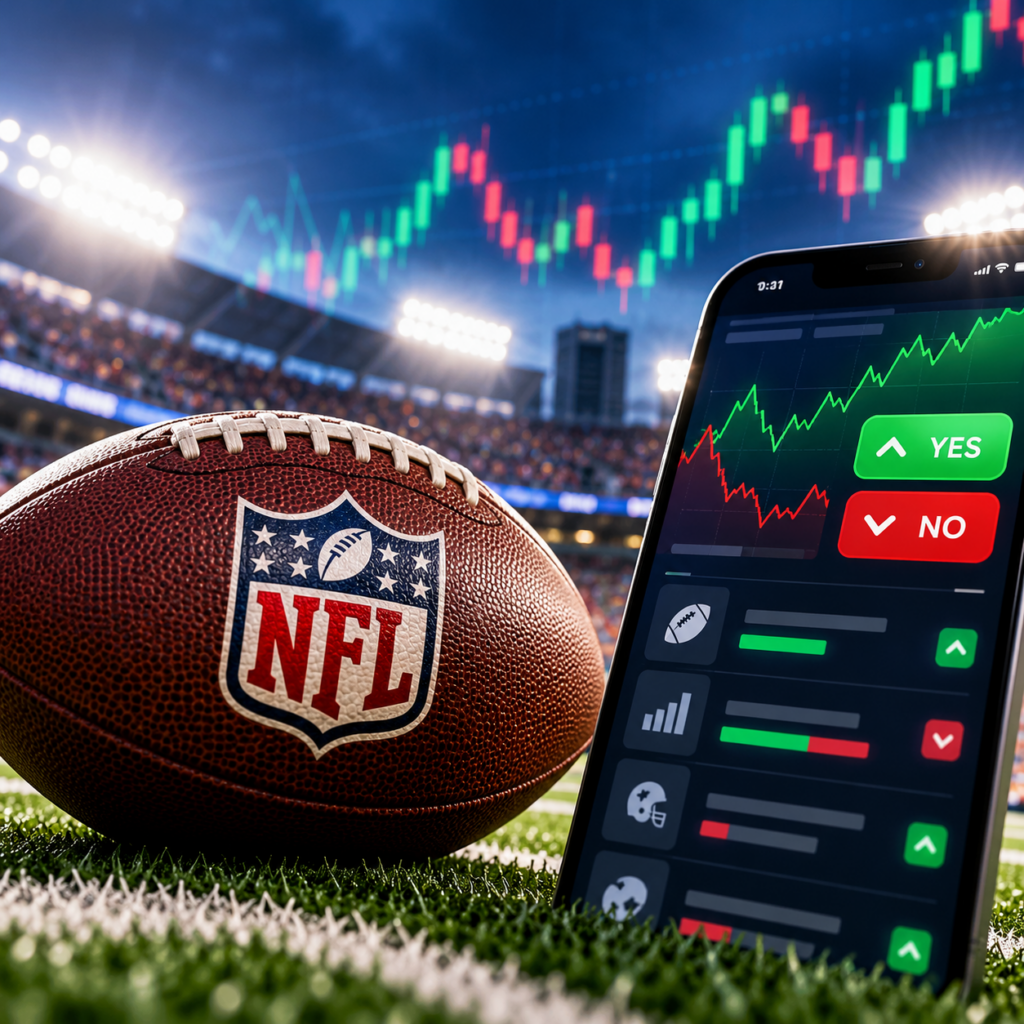
Every NFL Sunday now runs on two clocks. There is the one on the field, and there is the one ticking inside a set of live markets where prices move on every injury report, weather update and fourth-quarter drive.
Prediction markets have pulled that second clock into public view. Instead of a fixed number posted by a house, you get a price set by traders that updates in real time and can be entered or exited before the game ends. This guide explains how those markets work and walks through the platforms listing football contracts this season.
Key Takeaways
- An NFL event contract is a yes or no position on a stated football outcome that settles at a fixed value once the result is official.
- A contract price is read as the market’s implied probability, so 58 cents on the dollar reflects roughly a 58 percent implied chance.
- Most platforms let you close a position before settlement, provided there is a live bid.
- Platforms differ mainly on three things: how many markets they list on a single game, how many non-sports categories they cover and how their regulatory structure is documented.
What Is an NFL Prediction Market?
An NFL prediction market is a venue where users trade contracts tied to a specific, verifiable football outcome. The question is written plainly, such as which team wins a given game or which team is crowned champion at season’s end.
Each contract resolves to one of two values once the outcome is known. If your side is correct, the contract settles at its full value. If it is not, it settles at zero.
That structure is what separates a prediction market from a fixed-odds product. You are trading a position with a live price rather than locking in a static number, and that price keeps moving until the event is settled.
How Event Contract Pricing Works
Prices are typically quoted as a share of the eventual payout. A contract trading at 58 cents on the dollar reflects a market that currently prices the outcome at roughly 58 percent.
The same logic applies well beyond football. A golf tournament finish that comes down to the closing holes is the same kind of yes or no question, just expressed as a price rather than a leaderboard.
Those prices shift as information arrives. A starting quarterback ruled out on Friday, a shift in the forecast or a late trade can all move a market before kickoff, and in-game markets can move on a single play. As the familiar poker and football comparison goes, every call changes the read on the next one.
The practical difference for most people is exit flexibility. Because a contract has a live bid, a position taken on Wednesday can be closed on Sunday morning at whatever the market is paying, rather than being held to settlement.
How This List Was Put Together
Every platform below was checked against its own live product pages, press releases and public disclosures rather than aggregator write-ups. Where sources disagreed on a detail, that detail was left out.
Three things were prioritized. First, whether the platform actually lists football contracts rather than sports in general. Second, the breadth of market types available on a single game or season. Third, how clearly the platform documents its regulatory structure and risk disclosures.
State-level availability was deliberately excluded. That picture is changing quickly across the category, and each platform publishes its own current position.
NFL Prediction Market Platforms at a Glance
| Platform | Football market coverage | Wider category range |
| Fanatics Markets | Game moneylines plus a deep per-game market board and NFL futures | Sports, crypto, politics, culture, economy |
| Kalshi | Sports contracts including pro football, alongside season questions | Politics, economics, climate, culture, companies, financials |
| Polymarket | Game outcomes, player markets, awards and season futures | Politics, crypto, economics, tech, culture |
| FanDuel Predicts | Sports contracts across football, baseball, basketball and hockey | Financial benchmarks, economic indicators, entertainment |
| Underdog | Sports contracts on its own exchange, alongside a fantasy product | Sports led, with culture markets |
| Robinhood Prediction Markets | Sports event contracts within a brokerage app | Economics, politics, sports |
NFL Prediction Market Apps and Platforms
1. Fanatics Markets
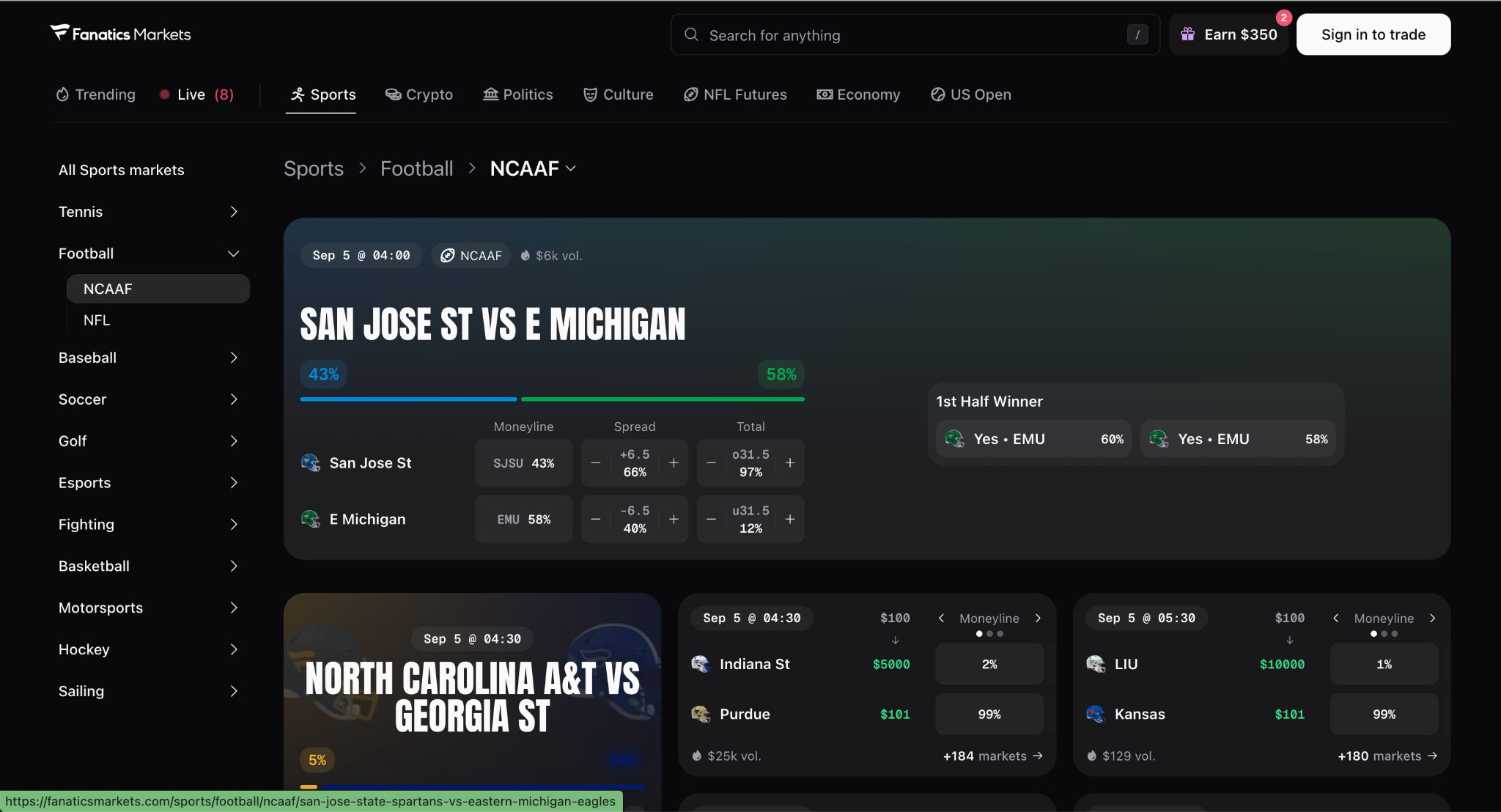
Fanatics Markets is a prediction markets platform inside the wider Fanatics ecosystem, and its football coverage is built around the depth of a single matchup. The NFL page lists upcoming games with moneyline pricing alongside a large secondary board for each fixture, with individual matchups showing several hundred additional markets each. Season-long coverage sits in a dedicated NFL Futures collection, and a separate Live section carries markets trading while games are in progress. For anyone comparing pro football betting odds across venues, that per-game depth is the point of difference.
Beyond football, the platform covers college football, basketball, baseball, soccer across more than a dozen leagues, tennis, golf, esports, fighting, motorsports, hockey and sailing, plus crypto, politics, culture and economy. Morton St. Trading Investments, LLC, doing business as Fanatics Markets, is a CFTC-registered futures commission merchant and NFA member, with contracts offered through Crypto.com | Derivatives North America under Nadex rules.
2. Kalshi
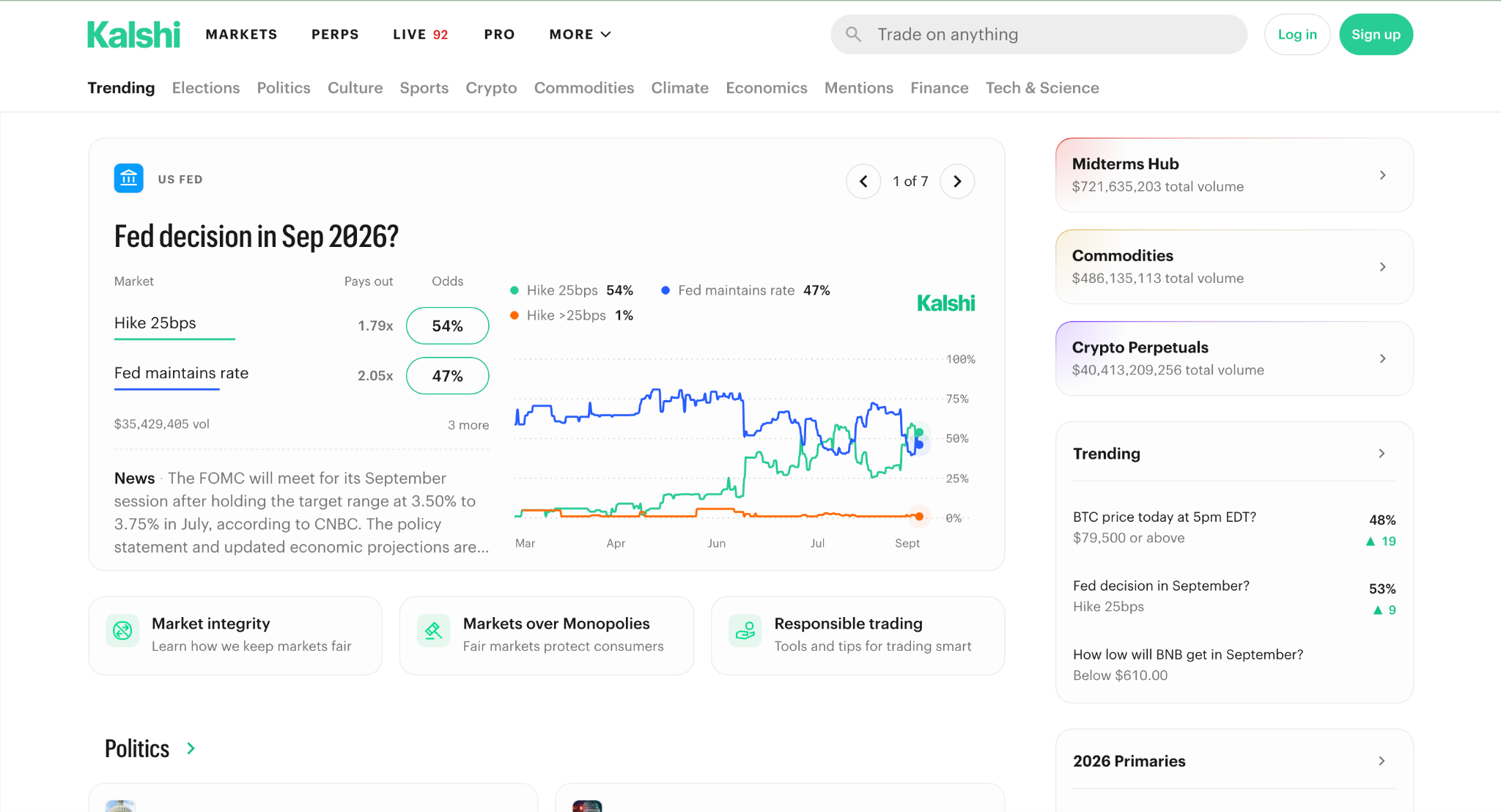
Kalshi is a CFTC-regulated event contract exchange and one of the longer-standing venues in the US category. Its board spans politics, economics, climate, companies, financials, culture and sports, with pro football sitting inside that sports vertical.
Kalshi has also operated as an exchange partner for other apps, supplying contract inventory to platforms that entered the category through brokerage or fantasy products before building their own infrastructure. That makes it a reference point for how the wider market is priced.
3. Polymarket
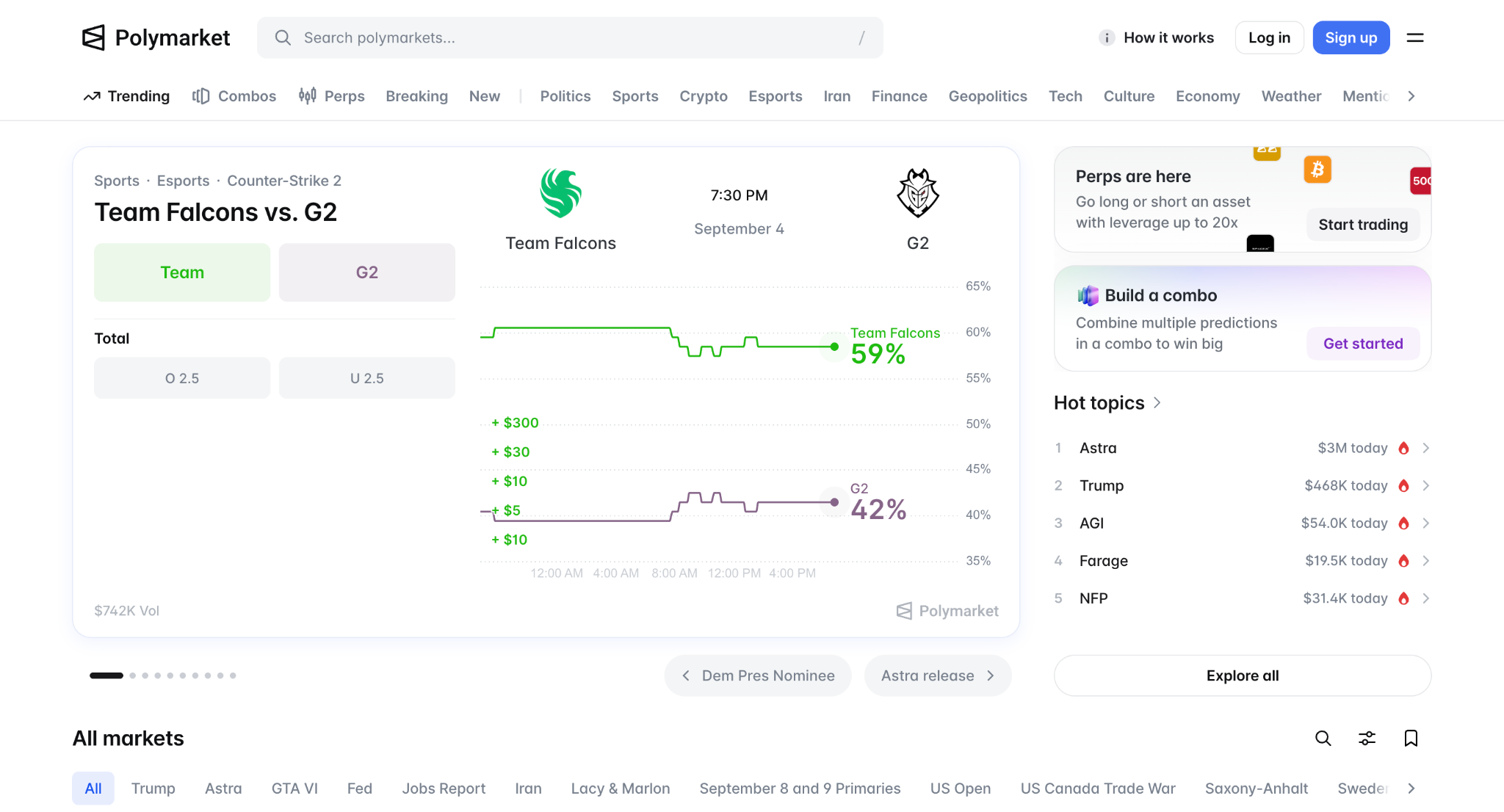
Polymarket runs a large global market catalogue covering politics, sports, crypto, economics and culture, with football among its sports categories. Prices are presented as implied probabilities, with positions able to be bought, sold or adjusted while a market remains open.
Domestic access runs through Polymarket US, which operates under a CFTC designated contract market licence held by QCX LLC. Its football board leans on breadth, extending to season and award questions well beyond individual game results.
4. FanDuel Predicts
FanDuel Predicts is the app of FanDuel Prediction Markets, a joint venture between FanDuel Group and CME Group. Contracts cover financial benchmarks and economic indicators such as GDP and CPI, alongside sports contracts across football, baseball, basketball and hockey.
The exchange arrangement has shifted since launch. Sports and novelty contracts route through Crypto.com while financial derivatives remain with CME Group, and accounts are opened with FanDuel Prediction Markets LLC, a registered futures commission merchant and NFA member.
5. Underdog
Underdog moved into event contracts from a daily fantasy and pick’em background, and its prediction markets sit in the same app as its fantasy games. That makes it a natural landing spot for users already comfortable with that interface.
In July 2026 the company launched its own CFTC-licensed exchange, having previously routed contracts through third-party venues including Kalshi and Crypto.com. It holds a designated contract market, a derivatives clearing organization and futures commission merchant registration, and its product remains sports led rather than broad category.
6. Robinhood Prediction Markets
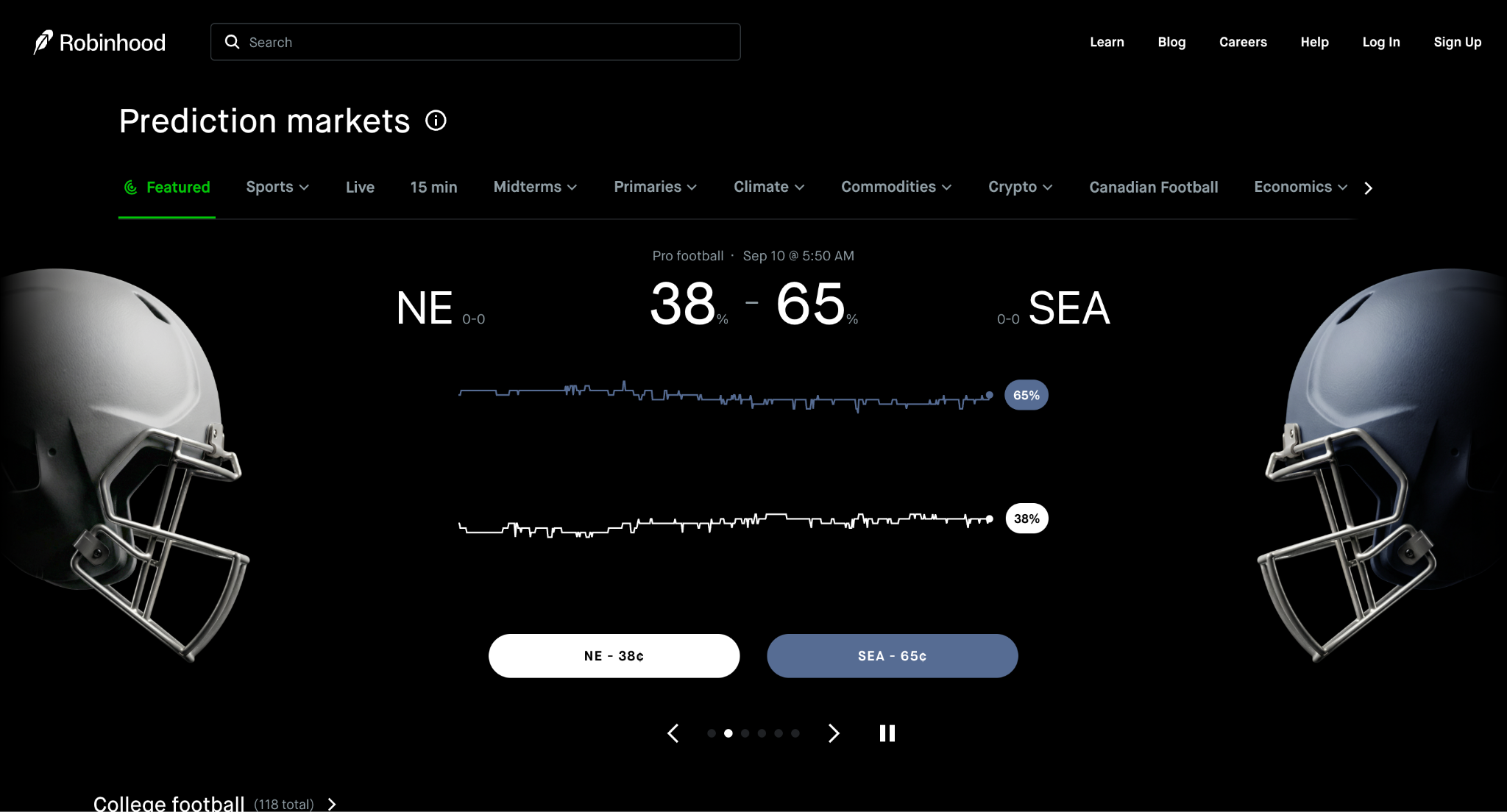
Robinhood added event contracts to its brokerage app and has expanded the category since. For existing users, the appeal is keeping contracts in the same account as other holdings.
Its infrastructure has changed as the category matured. Robinhood began by routing contracts through partner exchanges, and now also operates Rothera, a CFTC-licensed exchange and clearinghouse run as a joint venture with Susquehanna International Group, with some sports contracts routed there.
What to Compare Before You Choose
If you want the short version, weigh four things.
Market depth. Count the markets listed on a single game, not the number of sports on the homepage. A platform with one moneyline per fixture is a different product from one listing several hundred.
Category range. If you follow elections, inflation prints or crypto alongside football, a multi-vertical platform keeps everything in one place.
Regulatory structure. Check which entity holds your account, which exchange lists the contract and whether risk disclosures are easy to find.
Exit mechanics. Confirm how positions are sold before settlement and what that costs, because that flexibility is the main reason to use a market rather than a fixed price.
Understanding the Risks
Event contract trading involves a real risk of loss and is not appropriate for everyone.
Prices can move sharply on news, and a position that looks comfortable at kickoff can be worth very little by the second quarter.
As with a card on a game’s transfer market, the last clearing price is a guide to value, not a promise of what you will get when you sell.
Live data shown inside these apps is generally provided as is, for information and entertainment only, and can be delayed or incorrect. Past results are not necessarily an indication of future outcomes, and platforms say so directly in their own disclosures.
The legal treatment of sports event contracts is also still being tested. Courts have reached differing conclusions during 2026 and the question has been taken to higher courts, so the picture may look different by the end of the season.
Reading a contract price as a probability takes practice. It helps to set it against the kind of calls fans already make, such as a division race or the game-by-game predictions many team sites publish before the season.
Most platforms also publish risk management tools such as funding limits, trading breaks and self-exclusion options. Setting those before the season starts is easier than setting them in Week 12.
Final Thoughts
The football prediction market landscape has widened considerably, and the platforms above take genuinely different approaches to the same season. Some lead with depth on a single matchup, others with breadth across categories, and a few with the convenience of an account users already hold.
The right fit depends on how you actually follow the sport. Read each platform’s current disclosures, start small, and treat the price on screen as a live opinion rather than a settled fact.
Frequently Asked Questions
What is an NFL event contract? It is a yes or no position on a stated football outcome that settles at a fixed value once the result is official.
How do prediction market prices relate to probability? A contract price is read as the market’s implied probability, so a contract trading at 40 cents on the dollar reflects a roughly 40 percent implied chance.
Can you sell an NFL contract before the game ends? On most platforms yes, provided there is a live bid, and the price you receive is whatever the market is paying at that moment.
Are prediction markets the same as a sportsbook? No. Prediction markets are event contracts traded between participants at a market-set price, while a sportsbook posts fixed prices as the counterparty.
Which football markets are most commonly listed? Game winners, points totals, player performance markets and season futures such as division, conference and championship outcomes.