A poker player can spend ten minutes discussing a river call that took ten seconds to make. Was the sizing a tell? Which value hands made sense? Had the opponent found enough bluffs?
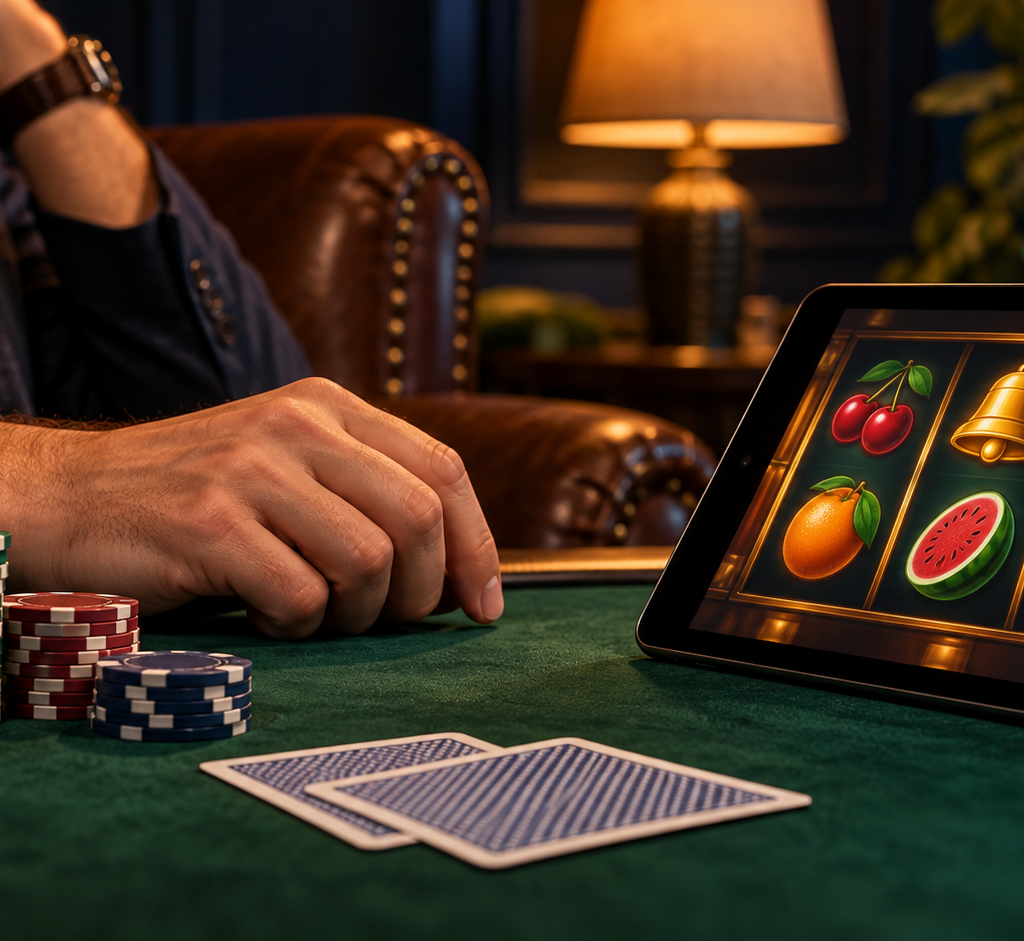
Then that same player might happily spend a few minutes on a slot, where none of those questions applies.
It can look like a contradiction. Poker rewards study, observation and decisions made with incomplete information. A random slot outcome offers no opponent to read and no bluff to catch. Yet for some players, that difference is precisely the attraction.
Not every game needs to become another problem to solve.
The pleasure of putting the analysis down
Even an enjoyable poker session asks quite a lot of you.
You track position, effective stacks, bet sizes and the habits of the other players. A change in one detail can alter the right decision. Away from the table, there are hands to review and situations you would like to handle better next time.
That work is part of poker’s appeal. It can also make poker feel demanding, particularly when you have spent an evening making difficult decisions.
A simpler game offers a different rhythm. You learn its rules, choose an appropriate play amount and watch the round unfold. There is no need to decide whether the player opposite you is capable of raising the turn with a draw.
For a player who enjoys casino-style entertainment, browsing a platform such as KingWins can be a change of pace. Recreational play can be enjoyed on its own terms, with no obligation to turn the session into a search for an edge.
That does not make chance-based games a cure for a frustrating poker session. Sometimes the best change of pace is to close the screen altogether.
Poker makes you responsible for difficult choices
One of poker’s frustrations is that the result rarely settles the argument.
You can make a good call and lose. You can make a bad call and get shown the one bluff that makes you feel brilliant. The uncertainty follows you home because there is always another interpretation to consider.
Poker also asks you to anticipate someone else’s decisions. Your best move depends partly on what they might do, what they believe you hold and how they expect you to respond. That interaction is central to game theory, which examines decisions whose outcomes depend on the actions of multiple participants.
With a random slot round, there is no opponent adjusting to your behavior. There was no alternative betting line that would have persuaded the reels to produce a different result.
A player can enjoy that absence of tactical responsibility. The attraction may be the theme, the animation or the anticipation of a feature, rather than satisfaction at having outplayed someone.
Choosing whether to play, how much to spend and when to stop still involves decisions. Having no control over the outcome does not remove responsibility for the session.
Enjoying randomness is different from understanding it
Poker players are accustomed to variance. Most have seen enough unlikely runouts to know that a favorite can lose and a poor hand can arrive at the river ahead.
But understanding poker variance does not automatically protect someone from mistaken beliefs in other games.
A slot that has gone quiet is not necessarily about to pay. A roulette color that has appeared repeatedly does not make the other color due on the next independent spin.
That expectation of an impending reversal is the gambler’s fallacy: treating previous outcomes as though they change the probability of a subsequent independent event.
The poker habit of searching for information can become unhelpful when it turns into searching for patterns in independent random outcomes. There is no tired opponent behind the screen whose mistakes will become more frequent if you wait long enough.
Game rules are worth studying. So are any features that explicitly retain progress between rounds. Imagining a hidden rhythm in a sequence of wins and losses is another matter.
The skills do not all travel together
Poker encourages useful habits: patience, emotional control and a willingness to question your first impression. Those habits can help you approach other games sensibly.
The tactical edge is less portable.
Reading opponents has no application to a slot. Choosing the right moment to bluff does not influence a roulette wheel. Blackjack offers meaningful player decisions, but sound strategy depends on its own rules and mathematics, not on how well you played last night’s cash game.
It is easy to carry a general sense of competence from one setting into another. A player who regularly beats a home game may feel comfortable around any casino game without having studied it.
Confidence is a poor substitute for knowing where your choices can affect the result.
Entertainment does not need an hourly rate
Poker players sometimes talk as though every session must justify itself financially. A game is soft, a seat is good or a tournament is worth the time.
That makes sense when assessing poker as a serious pursuit. It is less useful as a way to judge every leisure activity.
People spend money on films, concerts and games without expecting a return. Casino-style entertainment can be approached with the same willingness to accept a fixed cost, provided the budget is affordable and the player is comfortable receiving no prize.
Recreational coin play also offers a way to enjoy the experience without treating the balance as money. On sweepstakes platforms, players should distinguish recreational coins from those used for promotional sweepstakes participation and read the relevant entry and redemption rules.
There is no requirement to move from free participation to an optional purchase. Enjoying a game for a few minutes can be the whole experience.
Changing games should not become chasing losses
The least convincing reason to leave a poker table for another game is the belief that you will recover what you have just lost.
A difficult session can make immediate action feel attractive. You want a different result, preferably quickly. Moving to a faster game may give that impulse more opportunities without resolving it.
Keep leisure spending separate from any poker bankroll. Decide the limit before playing, rather than negotiating with yourself after each round.
The same applies to time. A short break that expands into another long session has stopped serving its original purpose.
If you are angry about a hand, still replaying an opponent’s comment or determined to finish the evening ahead, stepping away is a better decision than finding a new game.
There is room for more than one kind of enjoyment
Poker’s lasting appeal comes partly from the fact that there is always more to learn. A familiar situation can become interesting again when you notice a detail you previously missed.
Other games offer a less demanding kind of enjoyment. You may like their presentation, their pace or the simple uncertainty of what happens next.
A poker player can appreciate both. The distinction to keep clear is where skill has a role, where chance determines the outcome, and what you are prepared to spend for the experience.
You do not have to outsmart a game to enjoy it. You do have to recognize when there is nothing to outsmart.