

A tournament table rarely reaches the final hand with its original lineup intact. Eliminations leave empty chairs, fields contract, and staff must keep the remaining tables reasonably even. The announcement that “Table 14 is breaking” sounds routine, but the procedure protects blind order and random seat distribution.
Breaking a table is not the same as balancing one. A break removes an entire table and sends every remaining player elsewhere. Balancing usually moves one player because one table has become shorter than another. Confusing the two procedures leads to many familiar complaints about lost buttons and repeated big blinds.
A Table Break Uses a Fresh Draw
Under the current Poker Tournament Directors Association rules, players leaving a broken table receive new tables and seats through a two-step random process. Their former positions do not travel with them. Someone who had just paid the big blind might land in another blind, while a player expecting the button can lose that favorable position.
This is deliberate. Matching every departing player with an equivalent seat would become difficult when several tables have different empty chairs. It could also make assignments predictable. Random allocation gives the floor a consistent procedure that can be applied to the entire field.
A player arriving after a table break may be dealt in at the button, small blind, or big blind. The exception is a seat between the small blind and the button. That player waits until the button has passed because dealing a hand there would disrupt the established blind sequence.
Digital games face a related need to preserve an action during an interruption. After a wager is accepted at Jackpot Jill Casino, the server can retain the round identifier, stake, result, and balance entry if the connection drops before the animation ends. Reopening the game retrieves that recorded state, preventing a second bet or a different settlement for the completed round.
Balancing Follows a Different Logic
When only one player must move, tournament officials do not conduct a full random redraw. In flop and mixed games, the person due to post the next big blind generally moves to the worst available position at the shorter table. That position may be a single big blind, even when the move causes the player to post a big blind twice.
The small blind is excluded as the destination for a balancing move. Although it appears costly, it would allow the transferred player to avoid the full blind cycle. Moving the next big blind keeps the obligation attached to the player closest to paying it.
Three details explain most balancing decisions:
- Play may halt on a table that is at least three players short.
- The table selected for the move depends on the tournament’s predetermined breaking order.
- In stud-only events, players move according to position because there are no rotating blinds.
These rules reduce discretion, but they do not promise identical treatment in every orbit. Poker positions constantly change as hands finish at different speeds. The goal is a fair procedure, not a guarantee that nobody receives an inconvenient seat.
Timing Can Make a Move Look Unequal
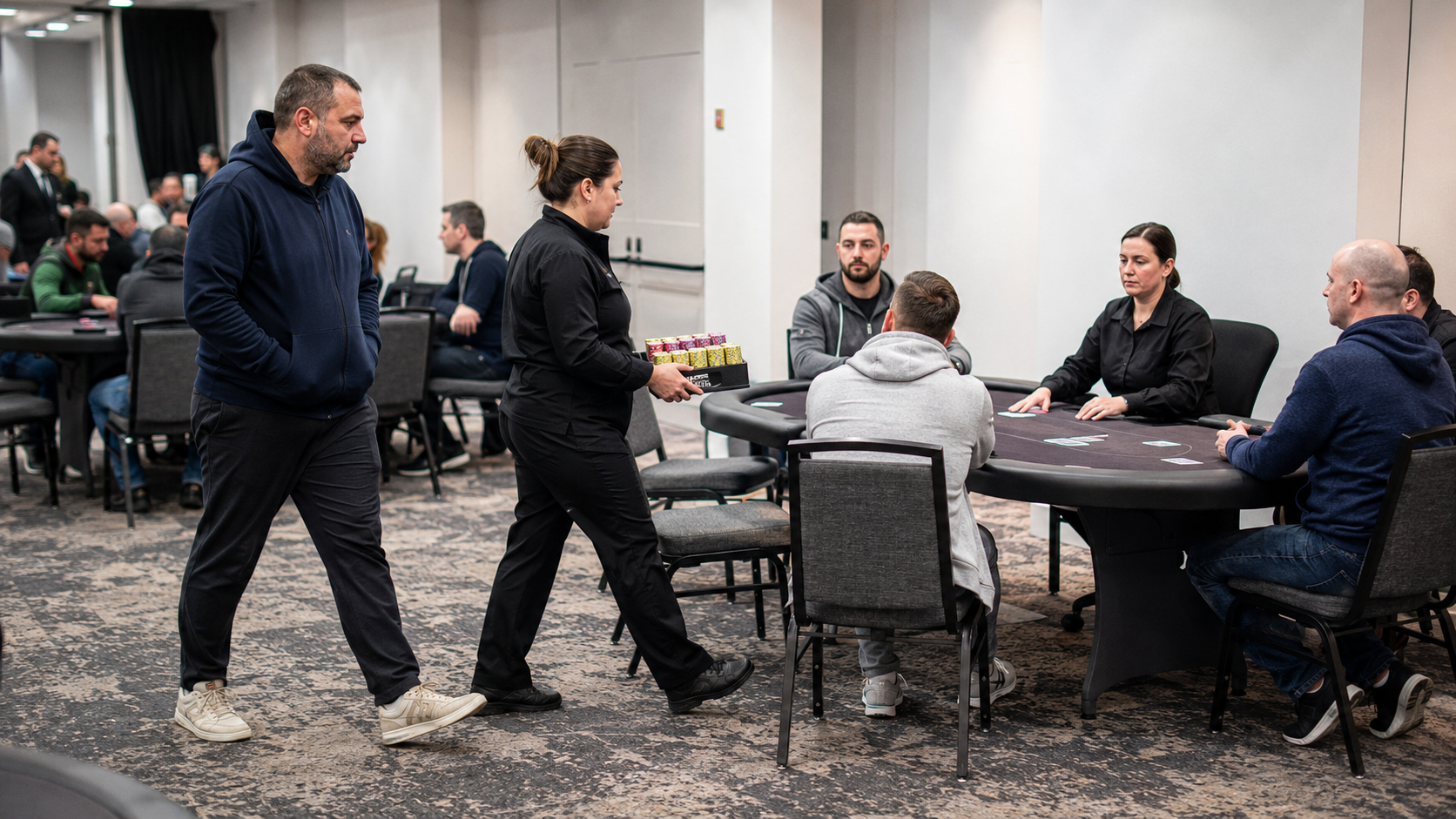
One table may complete three quick preflop hands while another plays a large pot through the river. An elimination during that interval can create a temporary imbalance. Staff must establish which hands have already started because a player cannot leave live cards and move a chip stack across the room.
The official Poker TDA rules define the start of a new hand as the first riffle, the press of an automatic shuffler button or a dealer push. This shared reference point determines whether a new blind level, table break or balancing instruction applies to the next deal.
Once a hand has started, the current limits and seating remain in effect until it finishes. Staff can then identify the correct player for a balancing move and transfer that stack without interfering with live action. A precise timing rule prevents two tables from interpreting the same announcement differently.
Moving Chips Requires Visible Control
Large tournament stacks should be transported by staff using racks rather than carried loose by a player. Chips need to remain visible and cannot be placed in pockets or bags. This protects the event against removal, substitution, and accidental mixing with chips belonging to another tournament.
A difficult seat after a move can feel personal, especially near the money bubble. It is usually the result of a rule designed to remove personal choice. Table breaking accepts short-term inconvenience so that hundreds of seat changes can remain random, traceable, and consistent as the tournament narrows toward its final table.